Why Strict Business Detail Accuracy Matters for Medical Clinics
Inconsistent addresses, phone numbers, or opening hours across public directories can make medical clinics and allied health practices harder for search systems and patients to trust.
By SyncMate
On this page
Patients searching for a local doctor, physiotherapist, or allied health practice rely on online maps and public directories when they need care. When someone tries to book an appointment or locate a clinic, an incorrect suite number or an outdated phone line creates immediate frustration for the patient. Search systems try to protect people from incorrect contact details, especially when health services are involved. If your practice information varies across medical directories, booking channels, and map applications, search tools tend to hesitate when deciding which details to display. For allied health practices, maintaining accurate, consistent records across public directories is critical for remaining findable in your local suburb.
Why search systems treat healthcare details strictly
Healthcare providers deal with sensitive patient decisions, which makes information accuracy vital for online search tools. When patients search for urgent care or a local clinician, search systems aim to provide accurate contact information to prevent wasted trips or calls to disconnected numbers.
Search tools and AI assistants often check address records, phone numbers, and operating hours across multiple public sources before recommending a medical clinic to local searchers. They cross-reference details from official databases, mapping services, and local registers to ensure consistency.
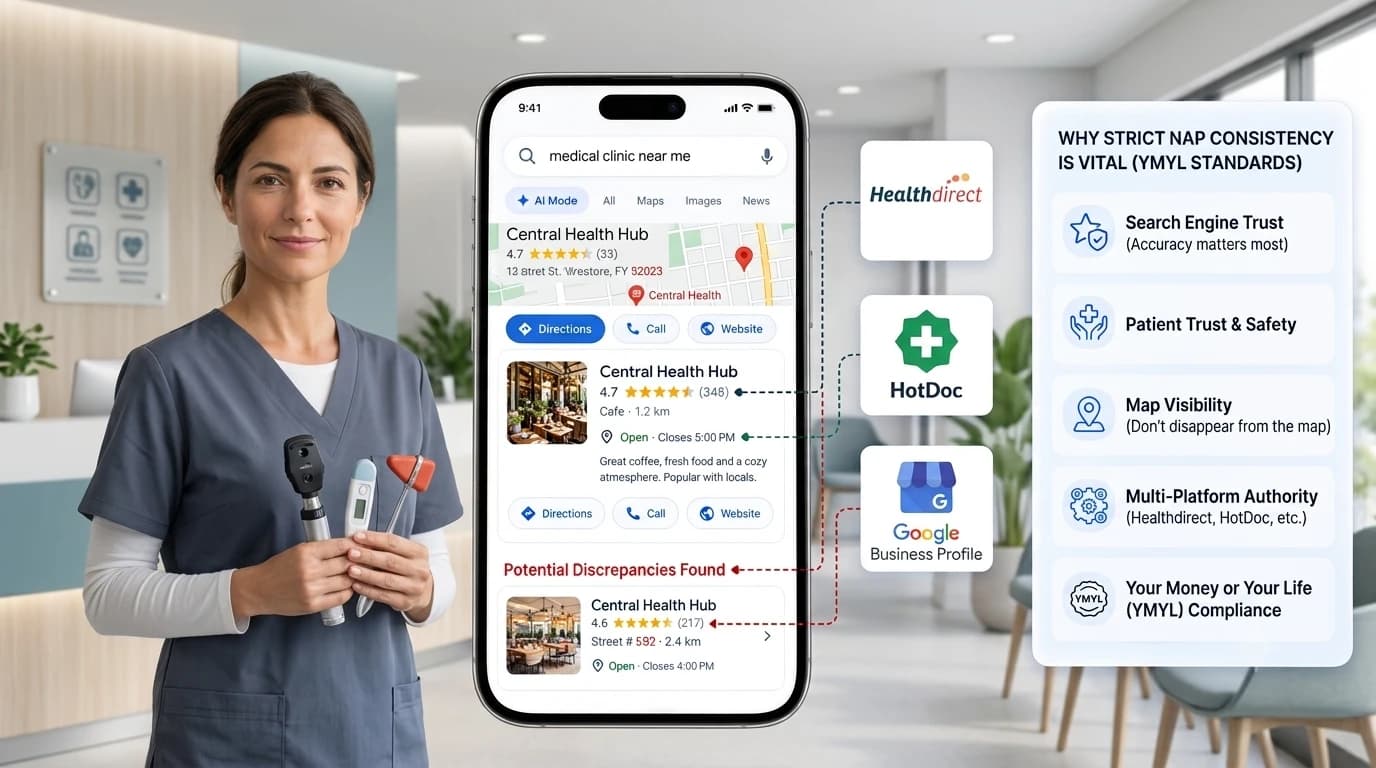
When directory records show conflicting details, search systems cannot be certain where your clinic is located or when your doors are open. This verification process helps prevent patients from travelling to closed offices or calling incorrect contact lines.
If a search system finds mismatched information across public profiles, it is less likely to show your practice details with full confidence. Maintaining consistent details across all public profiles gives search tools clear proof of your physical location and availability.
What happens when clinic details conflict across public records
Conflicting details across online sources create confusion for both search tools and patients seeking care. A simple discrepancy in a building suite number or phone extension can lead to misplaced bookings and missed care.
When a practice lists one reception phone number on its main website and a different direct line on a third-party directory, search systems encounter competing facts. These mismatches make it harder for machines to verify which details represent the current truth.
Patients face genuine difficulties when online map coordinates send them to a previous location or an unnumbered suite in a large health precinct. Search tools tend to lower their confidence in a business profile when key operational details disagree across public databases.
Maintaining consistent records ensures that whether a patient uses a traditional search engine or asks an AI assistant for a local health provider, the answer returned reflects your genuine address and phone number.
Common sources of detail errors for healthcare practices
Medical practices frequently update internal operations without updating every external public profile. These small oversights accumulate over time and create conflicting profiles across the web.
Changing suite numbers within a shared medical centre while leaving older room details on secondary directories is a frequent problem. Patients who follow outdated suite numbers may get lost inside large medical buildings.
Updating a main phone line while leaving direct extension numbers on secondary booking sites creates communication breakdowns. Reception teams end up missing calls from patients trying to confirm appointment details.
Listing informal practice names on one directory while using registered trading names on official profiles creates data fragments. Search engines may interpret these variations as two separate, unverified businesses.
Altering public holiday trading hours on your main website while leaving regular weekend hours published elsewhere causes patient confusion. Patients who arrive at a closed clinic during public holidays are unlikely to return.
How inconsistent details impact patient trust and appointment bookings
Inaccurate public information directly affects how easily patients can contact your reception team and arrive for scheduled appointments. When patients encounter broken links or wrong phone numbers, their trust in the clinic drops.
When a patient calls an outdated phone number or arrives at an old clinic address, they may look for another local provider who is easier to reach. Prompt communication and clear location guidance are essential for retaining new patients.
Inconsistent practitioner rosters or listed trading hours can lead to missed appointments, late arrivals, and unnecessary administrative work for reception staff. Staff members end up spending valuable time resolving scheduling confusion rather than caring for patients.
Clear, accurate contact details build immediate trust with prospective patients who need care quickly in your local suburb. Ensuring every directory reflects identical details protects your practice reputation and improves patient access.
Practical steps to maintain accurate clinic records
Keeping your clinic details correct requires a structured approach to reviewing public information across the web. A regular audit helps catch minor mismatches before they affect patient bookings.
Audit every primary directory, map application, and healthcare booking system where your clinic appears. Make a master list of all official business details, including exact spelling, formatting, and landline phone numbers.
Check that your street address, building suite, primary phone number, and operating hours match character for character on every profile. Even small formatting differences like St instead of Street can affect how search algorithms read data.
When practitioner schedules or holiday hours change, update every public record promptly to keep your details uniform everywhere. Assigning this task to a specific team member ensures public records remain accurate year round.
From SyncMate
How SyncMate helps
LandMark is SyncMate's local search product built for Australian small businesses and practices. It keeps your medical clinic or allied health practice findable and correctly described on Google, Apple, Bing, and AI assistants. SyncMate is a managed service set up on a 15-minute call for $150 a month inc GST for the first three months, then $250 a month with no lock-in contract, and your data comes with you.
Frequently asked questions
Updating hours on your main website while leaving regular hours published elsewhere causes patient confusion. People who arrive at a closed clinic during a public holiday are unlikely to return.
Related articles
Accurate business details are vital for medical clinics and allied health practices. When your address, phone numbers, and operating hours match across every online profile, patients can reach your team without unnecessary delays. Keeping your details updated protects your practice reputation and ensures search tools can present your practice with confidence. To ask a question or get help keeping your details consistent, visit our contact page.